By Mahrukh Farooq
Emotions run high as both characters face each other for the final face-off. The guilty party (in this case, the husband) has been accused of remarrying without the consent of either his family or his wife who, after crying a river of tears, ultimately plays the role of sacrificial lamb, allowing such a transgression to take place. The scene in question is nothing we haven’t seen before, save for one minor detail; one of the actors performing the scene happens to be a former musician.
Yes, you read that correctly. The aforementioned scene is actually from the hit TV soap ‘Nikah’ starring Sonia Hussain, Sanam Chaudhry and former lead singer of Call, Junaid Khan. After making his first appearance in the sitcom ‘Kabhi na Kabhi’ back in 2011, Junaid has, over the years, made a successful career in television, his acting prowess drawing appreciation and admiration from his fans and critics.
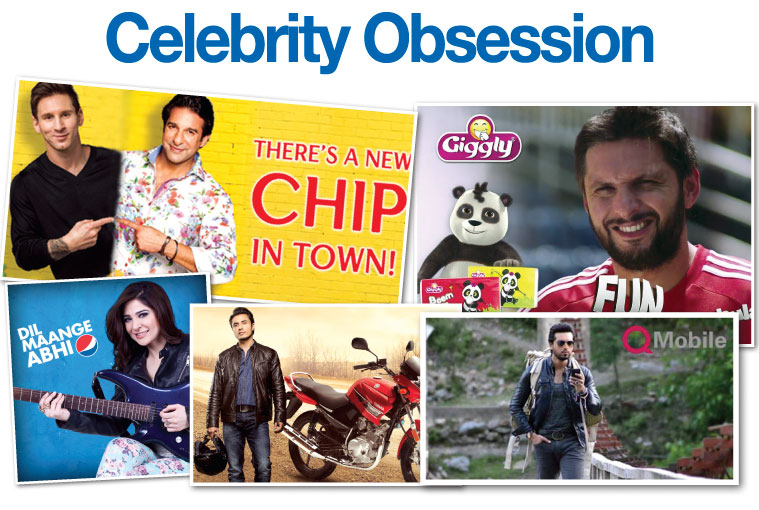
The trajectory of Junaid’s career, on a standalone basis, need not necessarily cause people to sit up and take notice. However, it represents just one of many such career shifts (or efforts to ‘branch out’ as many are wont to emphasize) performed by people belonging to professions that are otherwise completely different. Take, for example, Wasim Akram; from a prison escapee/stern family elder in a score of ads for Ufone to a door-to-door salesman, prone to performing elaborate cleaning exercises in front of hundreds of housewives in Ariel, the former cricketer/commentator/television celebrity seems to have done it all.
Then there’s Fahad Mustafa, the chocolate hero-turned-commercial star, who is jumping from one advertisement to the next like some sort of ratings-obsessed rabbit. And please, let’s not forget about the immensely image-conscious Shahid Afridi, who has appeared in virtually everything under the sun, from Head & Shoulders Shampoo to the cringe worthy Boom Boom Bubble Gum. One cannot help but wonder, though, whether the cricket sensation is just as persevering and determined about maintaining his image on the cricket ground as well. He is sought-after for TV ads but he does not give a good account of himself when playing.
As one can clearly see, the list of such people is endless. That raises the question about the origins of the trend - when did all start? Does the practice represent our desire to interact with our celebrities on a completely different level? More importantly, is it working?
“Advertisers often make use of endorsers or representatives as trustworthy sources of persuasion for consumers’ attitudes,” say Sadia Aziz, Usman Ghani and Abdullah Niazi of the Institute of Management Sciences, Peshawar, in their paper, ‘Impact of Celebrity Credibility on Advertising Effectiveness’ published in the Pakistan Journal of Commerce and Social Sciences.
In 2013, the three conducted a study that aimed to judge the impact of celebrity credibility on advertising effectiveness in terms of customer attitudes towards advertisements, the brand as well as the purchase intention. The study also highlighted the differences in responses towards advertisements of brands featuring celebrities compared to those using relatively less known actors. “Our findings suggest that the respondents considered the famous celebrities of the brand as the most credible celebrities, having positive impact on consumers’ attitude towards the advertisement, attitude to the brand and their favourable purchase intentions as compared to the unknown celebrities with less credibility.”
The aforementioned conclusion is just a confirmation of what we already know; that the act of matching celebrities with certain products is bound to draw more attention and generate massive appeal, a cue we seemed to have picked up on from
|
|
|
international advertisers and marketers.
“The affinity consumers have for certain celebrities can greatly influence their purchases. People may have the attitude, ‘If the product is good enough for her, it’s good enough for me.’” explains Rick Suttle from the Houston Chronicle. “Essentially, the testimonial of the local celebrity adds instant credibility to a small company’s product.”
Stephanie Pappas, a contributor on the digital science publication, LiveScience, describes human beings as social creatures who live in an environment where it is beneficial to pay attention to the ones at the top. “Celebrity fascination may be an outgrowth of this tendency, nourished by the media and technology,” she says. “[And] the media exploits this tendency.”
However, now it seems as if the narrative is shifting slightly towards non-celebrity advertising. A number of experts are beginning to question the feasibility of using celebrities in commercials, especially when there seems to be no obvious return attained by it. “If all the attention is focused on the celebrity and not the brand, you’ve got a case of ‘video vampire,’ in which many ads in the genre do a better job in gaining celebrity exposure than they do in generating notice for the brand,” says Jeri Smith, a contributor at Marketing Insights, the e-newsletter of the American Marketing Association (AMA).
“For example, in our most recent study of Super Bowl ads, the average celebrity recognition was 78%, while the average brand linkage for those same ads was just 28%. In other words, three of four of those who engaged with the commercial knew the celebrity while just one in four could connect the commercial to the correct brand.”
Marketing analysts like Jeri insist on taking the safer route by not rejecting celebrity endorsements outright and instead suggesting that businesses should establish a clear connection with just one celebrity in order to avoid confusion. Other advertising experts, however, are generally more unabashed in their opinions, going to the extent of saying that celebrity endorsements should be avoided altogether. “Over the course of last year, time and time again we observed incredibly low effectiveness scores of TV ads starring celebrities”, explained Peter Daboll, contributor at the advertising resource site, Ad Age. “From Tiger Woods to Donald Trump, we found that with rare exception, celebrity endorsements were largely ineffective and failed to yield the benefits popular wisdom promises.”
A reasonable theory, perhaps. But can the same be said for the scores of celebrities starring in drama serials? “The main reason touted by former musicians and models for their decision to enter the television industry is that there isn’t enough money to be made from the sector that they are coming from.” Says Pakistani music composer and drummer, Louis J. Pinto a.k.a Gumby. “What is really astonishing is that they continue to get offers for roles when it is evident that they just cannot act! Ayesha Omar is a prime example. She has delved in everything, from modeling to painting to cooking to singing to acting and it seems as if she doesn’t want to leave any stone unturned.”
When asked whether such people are justified to shift gears in their professions, Gumby’s expressions transform into one of absolute disdain. “You work with what you have. I could have also gone on a completely different tangent if my objective was to just make money and nothing else. But I didn’t. I stayed because I make music for the love of it.” He adds, “Even if you do decide to veer off onto a different path, it should be one that makes sense and that complements your skills and abilities.
Going into acting just because everybody else is doing the same and it pays better is a silly excuse.”
Justified or not, one cannot deny the sheer number of options now available to celebrities looking to cash in on their image. How long is it going to last is anybody’s guess.
|
|